Learning how to make a latte at home is mostly about the milk. The coffee part is short: a couple of shots of espresso, or a strong brew if you have no machine. The milk is where a homemade drink starts to taste like the one from your favorite cafe, hot, slightly sweet and topped with a soft layer of foam. This guide walks through the basic recipe, four ways to make the coffee base, three ways to froth milk without a steam wand, an iced version and a few flavor ideas.
What is a latte?
A latte is espresso with a lot of steamed milk and a thin layer of foam. Food Network Kitchen describes the classic proportion as about one-third espresso to two-thirds steamed milk, and notes that many cafes and recipes use even more milk for a creamier cup with a gentler coffee flavor.
That is also what separates it from its relatives. A cappuccino has less milk and a deeper layer of foam, a flat white is smaller and stronger, and a cortado is roughly half espresso and half milk. The Kitchn makes a useful point here: these drinks sit on a continuum, and at home you can adjust the espresso, milk and foam until it tastes right to you.
How to make a latte at home: the basic recipe
This is the version with an espresso machine or a capsule machine, adapted from Food Network Kitchen.
- Brew the espresso. Make two shots of espresso, about 2 ounces, and pour them into a mug. For a hotter drink, fill the mug with boiling water first, then pour it out just before the espresso goes in.
- Heat the milk. Warm about 1/2 cup of milk to about 150°F, hot but not boiling. Food Network Kitchen heats it in a small saucepan on low with a thermometer, stirring often.
- Froth it. Use a steam wand, a handheld frother or one of the no-gear methods below. Tap the jug on the counter a few times to break up large bubbles.
- Pour. Pour the milk into the espresso, holding back the foam with a spoon.
- Top with foam. Spoon the reserved foam on top. This is also the moment for latte art if you want to try.
Want a bigger, milder drink? Fork in the Kitchen uses 6 to 8 ounces of whole milk with two shots of espresso, which gives a larger, creamier cup.
Can I make a cafe latte at home?
Yes. A cafe latte is the same drink, and the name simply means coffee with milk. Knowing how to make a latte at home really comes down to two parts. You need a strong coffee base and hot, frothed milk; everything else is a matter of taste. A home version may not match the texture of milk from a commercial steam wand, but it can come close.
How to make a latte without an espresso machine
If you are wondering how to make a latte without an espresso machine, the answer is concentration. The Kitchn notes that steamed milk added to regular American-style coffee does not quite give you the flavor of a real latte, because espresso is intense enough to stand up to all that milk. So the goal is a small amount of very strong coffee. Here are four ways to get there.
| Coffee base | How much | Notes from the source |
|---|---|---|
| Espresso machine | 2 shots (about 2 oz) | Food Network Kitchen’s base recipe |
| Moka pot | about 60 ml coffee to 150 to 180 ml frothed milk | Coffee Hero’s suggested ratio |
| AeroPress | 18 to 20 g fine coffee, 60 to 80 ml water at 85 to 90°C, 60-second steep | Coffee Hero’s concentrate method |
| Strong French press | 14 to 16 g coffee per 100 ml water, 4-minute steep, use 80 to 100 ml | Coffee Hero: about double the usual dose |
| Strong brewed coffee | about 1/2 cup | Fork in the Kitchen’s swap for 2 shots |
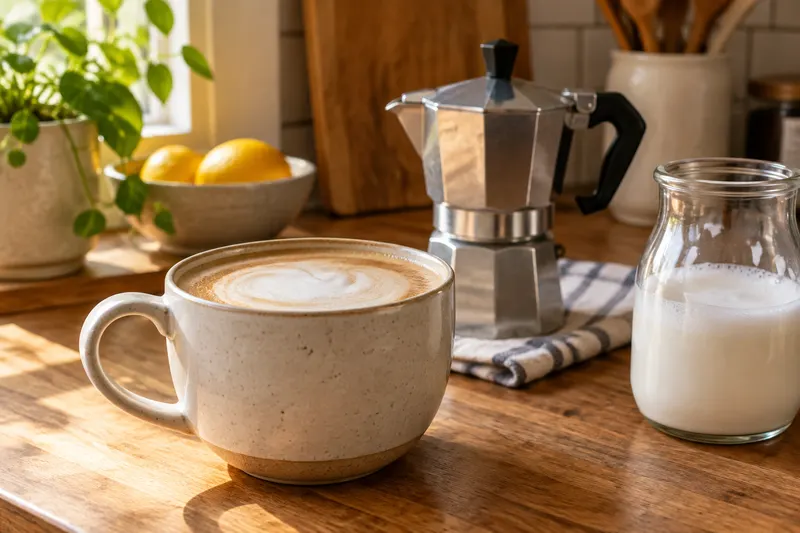
Moka pot latte
Coffee Hero calls the moka pot the best no-machine option, because its stovetop coffee is closer to espresso than other methods. Fill the bottom chamber with hot water up to the safety valve, fill the basket with medium-fine coffee and level it without tamping, then heat on medium. Take it off the heat as soon as the top chamber fills and you hear a gurgle. For a moka pot latte, Coffee Hero suggests about 60 ml of coffee with 150 to 180 ml of frothed milk, adjusted to taste.
AeroPress latte
The Kitchn’s writer uses extra-strong coffee from an AeroPress, calling it almost, but not quite, espresso. Coffee Hero’s version uses 18 to 20 g of finely ground coffee and 60 to 80 ml of water at around 85 to 90°C, a 60-second steep, then a slow, steady press.
French press latte
A French press can make both the coffee and the foam. Coffee Hero brews it at about double the usual strength, 14 to 16 g of coffee per 100 ml of water instead of 7 to 8 g, steeps it for 4 minutes and presses slowly. Use about 80 to 100 ml of that brew as the base.
Do you need an espresso machine to make a latte?
Not for a good homemade drink. Strictly speaking, a latte is built on espresso, and a machine with a steam wand will get you closest to a cafe drink. But any of the strong bases above makes a cup that tastes like a latte, and The Kitchn’s own recipe was written for kitchens without an espresso maker.
Can you make a latte with pour-over coffee?
Yes, as long as it is brewed strong. Fork in the Kitchen swaps two shots of espresso for about 1/2 cup of strong coffee, and suggests using a little more coffee and a little less milk when you do, so the coffee flavor still comes through. Regular-strength pour-over will taste more like coffee with hot milk.
How to froth milk without a steam wand
Here is how to froth milk at home with tools you probably already have. Each method needs hot milk; froth it in a container with plenty of room, because it roughly doubles in volume.
The jar method
The Kitchn’s method: fill a jar no more than halfway with milk, microwave it uncovered until warm, about 30 seconds, then screw the lid on tightly and shake as hard as you can for 30 to 60 seconds, until it is frothy and roughly doubled. Fork in the Kitchen heats milk in a mason jar for about 1 1/2 minutes, adding 30-second bursts if needed, then shakes it for 30 seconds to 1 minute.
Two safety notes from Fork in the Kitchen: never put a metal lid in the microwave, and open the jar slowly with a towel, in case pressure has built up inside.
The French press method
Heat the milk until hot but not boiling, around 60 to 65°C. Pour it into a French press no more than one-third full, put the lid on and pump the plunger quickly up and down for 30 to 60 seconds. Coffee Hero says the milk will roughly double and turn light and airy.
The saucepan and whisk method
No jar with a lid? Fork in the Kitchen heats the milk in a small saucepan and whisks it hard until foamy. A handheld electric frother does the same job faster.
Latte ratio and milk temperature
There is no single correct latte ratio. Recipes give you a range, and you can move within it:
- Classic: about one-third espresso to two-thirds milk (Food Network Kitchen).
- Everyday home version: 2 shots of espresso (about 2 oz) with 1/2 cup of milk (Food Network Kitchen).
- Larger, milder cup: 2 shots with 6 to 8 ounces of milk (Fork in the Kitchen).
- Moka pot: about 60 ml coffee to 150 to 180 ml milk (Coffee Hero).
For temperature, Food Network Kitchen heats the milk to 150°F, and Coffee Hero gives about 60 to 65°C for frothing. Both stop short of boiling. Fork in the Kitchen puts it simply: you want the milk hot, but not boiling.
Which milk froths best?
Milk matters more than most people expect when they learn how to make a latte at home. Food Network Kitchen calls whole milk the best choice for a latte, because its fat gives a sweet, rich taste and a loose, silky foam. Two percent and skim milk also foam well but taste lighter; The Kitchn actually uses 2% or nonfat milk for its jar method.
For non-dairy milks, Food Network Kitchen ranks oat milk first for a rich, creamy foam, then almond milk, which froths best at room temperature, then soy. It suggests skipping rice, macadamia and cashew milk, which do not froth well. Coffee Hero recommends a barista-style oat milk if you want plant-based milk that foams reliably.
How do you sweeten a latte?
Stir the sweetener into the espresso before the milk goes in, so it dissolves evenly. The Kitchn suggests a teaspoon of vanilla or almond extract, or a sweetened flavored syrup. Liquid sweeteners such as simple syrup mix in most easily, especially in a cold drink. If you like flavored creamers, a homemade coffee creamer can do the sweetening and flavoring in one step.
A simple vanilla latte recipe
Fork in the Kitchen’s vanilla version adds vanilla syrup to the milk before frothing: heat the milk in a jar, stir in the syrup, then shake until it doubles and pour it over the espresso. The writer prefers vanilla syrup to plain extract, because extract adds flavor but no sweetness.
Other easy flavors:
- Cinnamon or cocoa: a light dusting on the foam, as The Kitchn suggests.
- Pumpkin spice: Food Network Kitchen heats milk with pumpkin puree, sugar and pumpkin pie spice, whisks it foamy and pours it over espresso.
- Caramel or hazelnut: a little flavored syrup in the espresso.
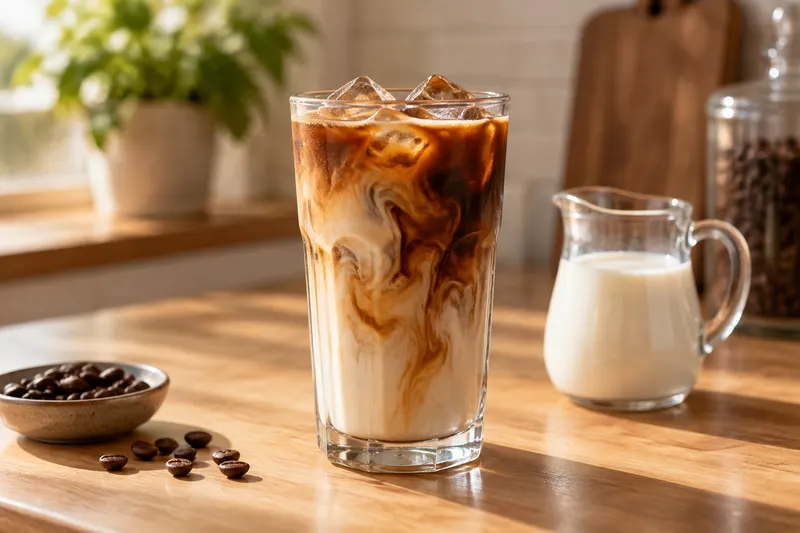
Iced latte recipe
An iced latte skips the frothing. This version follows Food Network Kitchen:
- Fill a tall glass with ice.
- Brew two shots of espresso (about 2 ounces) and pour them over the ice. Cold brew works as a substitute.
- Add about 1 ounce of liquid sweetener, such as simple syrup, if you like it sweet.
- Pour in about 1/2 cup of cold milk and stir.
For a frothier drink, shake everything in a cocktail shaker and strain it over fresh ice. For more ideas on keeping cold coffee from tasting watery, see our guide on how to make iced coffee at home, or try a cold brew base.
Homemade latte tips and common fixes
A homemade latte usually goes wrong in one of a few predictable ways.
| Problem | Likely cause | What to try |
|---|---|---|
| Tastes like milky coffee, not a latte | Coffee base too weak | Use espresso, a moka pot or a double-strength brew |
| Thin foam that disappears | Milk too cold, or jar too full | Heat the milk first; fill the jar halfway or less |
| Flat, cooked taste | Milk overheated | Stop at about 150°F, before it boils |
| Big, soapy bubbles | Large air pockets left in the foam | Tap the jug on the counter, swirl, then pour |
| Drink cools too fast | Cold mug | Warm the mug with boiling water first |
| Sweetener sits at the bottom | Added to cold milk or ice | Stir it into the hot espresso first |
How to make a latte at home: quick checklist
If you only remember one thing about how to make a latte at home, make it this: strong coffee, hot milk, a little foam. Use two shots of espresso or a strong concentrate, heat about 1/2 cup of milk until hot but not boiling, froth it in a jar, a French press or with a whisk, pour the milk in while holding back the foam, then spoon the foam on top. From there, change one thing at a time, the milk, the ratio or the syrup, until the cup tastes like yours.
Sources
- Food Network Kitchen (Grace Elkus). How to Make a Latte.
- The Kitchn. How To Make a Latte at Home.
- Fork in the Kitchen. Homemade Latte.
- Fork in the Kitchen. Easy Homemade Vanilla Latte.
- Coffee Hero. How to Make a Latte at Home (Without a Machine).