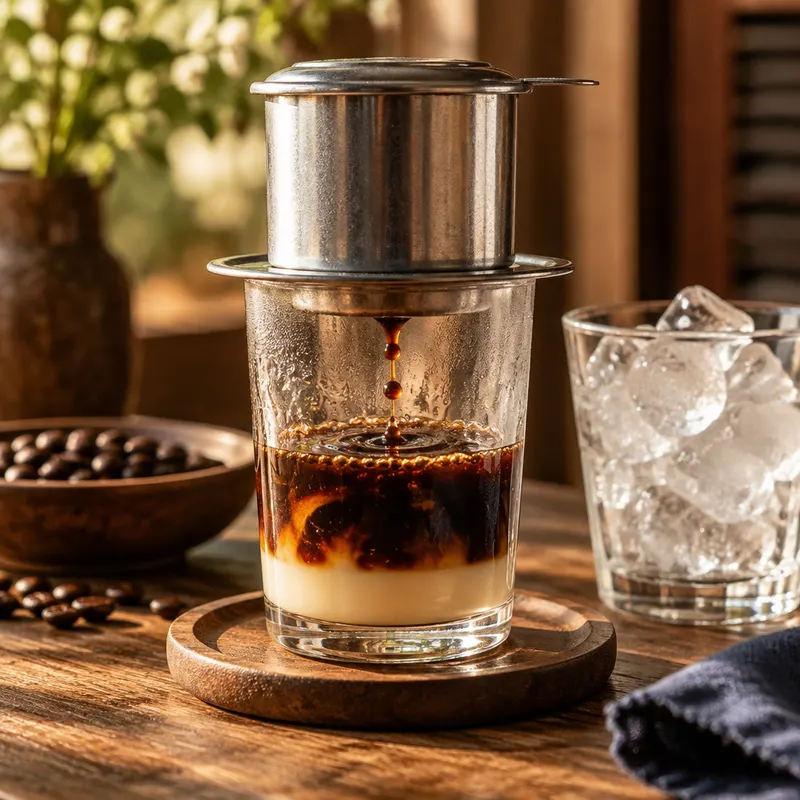
Cold brew vs iced coffee is one of the most common mix-ups on a cafe menu. Both arrive cold, both come in a tall glass full of ice, and both can be black or creamy. The difference is in how the coffee was made before it ever met the ice: one was brewed with hot water and chilled, the other never saw heat at all.
That single step changes the taste, the time it takes, the price on the menu and the way you make it at home. This guide walks through each one, side by side, with simple ratios you can use in your own kitchen.
Cold brew vs iced coffee: the short answer
Iced coffee is regular coffee brewed with hot water, then cooled down and poured over ice. Cold brew is coarse ground coffee steeped in cold or room-temperature water for many hours, then strained. Canteen gives about 12 to 24 hours for the steep, and Stōk gives 10 to 24 hours.
So the difference between cold brew and iced coffee is not the serving temperature. It is the brewing temperature. In the words of Peet’s Coffee, with cold brew “there’s no heat used at all.”
| Iced coffee | Cold brew | |
|---|---|---|
| Water used to brew | Hot | Cold or room temperature |
| Brewing time | A few minutes | About 12 to 24 hours |
| Typical taste | Bright, crisp, more like hot coffee | Smooth, round, softer and less acidic |
| Grind | Medium, as for drip or pour-over | Coarse |
| Made in | Single cups or a pot | Batches, often a jar or pitcher |
| Ready to drink | Right away, once cold | The next day |
| Common at home | Leftover or fresh coffee over ice | A concentrate you dilute |
What is iced coffee?
Iced coffee is any coffee brewed hot and served cold. A cafe may brew it on a drip machine or a pour-over cone, then cool it and pour it over ice. Canteen sums it up as coffee that is “brewed hot and cooled down” and usually ready in minutes.
The catch is the ice. Hot coffee poured over ice melts a lot of it, and the drink can turn thin. That is why good recipes brew iced coffee a little stronger than usual, or cool it before it touches the glass. Our guide on how to make iced coffee at home covers three easy methods.
Is iced coffee just hot coffee with ice?
Mostly, yes, but the best versions are planned that way. Driven Coffee calls plain hot coffee poured over ice the most basic form of iced coffee, and points to flash brewing as the better approach, because the coffee is made stronger from the start to allow for the melting ice.
What is cold brew?
Cold brew is coffee made with time instead of heat. You stir coarse grounds into cold water, leave it to steep, then filter out the grounds. Most home recipes make a strong concentrate first and dilute it with water or milk when you pour a glass.
Counter Culture Coffee uses about 1 part coffee to 8 parts water for a concentrate, steeped in the fridge. Peet’s starts stronger, at about 1:5, and steeps for at least 12 hours. Our step-by-step guide on how to make cold brew coffee has a full ratio table.
Is cold brew just iced coffee?
No. Cold brew is often served over ice, so it is a kind of iced drink, but it is not iced coffee in the usual sense. Iced coffee starts hot. Cold brew is never heated, and that is the whole point of the method.
Cold brew vs iced coffee taste
When you compare cold brew vs iced coffee taste, the brewing temperature is the reason they differ. Peet’s explains that hot water pulls out tannins, bitter oils and other compounds, while cold water leaves more of them behind in the grounds.
- Iced coffee tastes closest to a hot cup: bright, crisp and aromatic, with more of the sharp, fruity notes. Canteen describes it as “bright, acidic, aromatic.”
- Cold brew tastes rounder and softer, often with chocolate or caramel notes and less bite. Peet’s describes it as “lower-acidity” and full-bodied.
Neither is better in general. If you love the lively taste of a light roast, iced coffee or flash brew keeps it. If hot coffee tastes harsh to you, cold brew may suit you more.
Does cold brew or iced coffee taste stronger?
Cold brew concentrate usually tastes stronger, because it uses much more coffee for the water. Once it is diluted, the glass can taste as strong or as mild as you like. Canteen notes that how strong either one tastes depends on the beans, the grind, the brewing method and the brewing time, not just the name of the drink.
Flash brew vs cold brew
Flash brew, also called Japanese iced coffee, is a middle path. You brew hot coffee directly onto ice, so it cools the moment it lands.
Peet’s explains the idea with a ratio: if you normally brew at 1 part coffee to 16 parts water, use 8 parts hot water and put the other 8 parts in the server as ice. In our iced coffee guide, the same idea works out to about 20 g of coffee, 160 g of hot water and 160 g of ice. Driven Coffee suggests a simpler rule: cut your usual brewing water by about 30% and put ice in the carafe.
Flash brew vs cold brew comes down to what you want from the cup. Flash brew is fast and keeps the bright, aromatic side of the coffee, because it is still brewed hot. Cold brew is slow and gives the smooth, mellow side. Texas Coffee School notes that the quick cooling helps hold on to aroma.
Time, batch size and storage
Time is often what decides it at home.
- Iced coffee: a few minutes, one glass at a time. Good when you want a cold coffee now.
- Cold brew: five minutes of work, then a night of waiting. Good when you want coffee ready for the next few mornings.
Canteen points out that cold brew works well for meal prep: brew a big batch once and you have coffee for the days ahead. For storage, the sources differ. The American Homebrewers Association suggests keeping strained cold brew in the fridge for up to a few days, while Peet’s says its concentrate stays fresh for up to 10 days in an airtight container. A few days is the cautious default; taste it and pour it out once it goes flat.
Iced coffee is best fresh. Brewed coffee left sitting for long tends to taste stale, so make it close to when you drink it.
Why is cold brew more expensive?
Cold brew usually costs more at a cafe because it uses more coffee and takes far longer to make. Canteen notes that iced coffee is often the cheaper menu option, since cold brew takes more time and more beans. Peet’s adds that cost per cup is part of the difference between the two.
At home the picture changes. Peet’s suggests that brewing your own with good beans gives the lowest cost per cup, and the only gear you really need is a jar and a filter. A cold brew made at home can work out cheaper than a cafe iced coffee.
Cold brew vs iced latte and iced Americano
Cold brew vs iced coffee is the main question, but two espresso drinks often join the comparison.
Cold brew vs iced latte. An iced latte is espresso poured over ice with cold milk, and the milk is the larger part of the drink. Cold brew is a brewed coffee, usually served black or with a splash of milk. You can also use cold brew concentrate in place of espresso for an iced latte at home.
Cold brew vs iced Americano. An iced Americano is espresso poured over cold water and ice. It tastes sharper and more roasty than cold brew, because the espresso is brewed hot and under pressure. Cold brew is smoother and needs hours.
Both espresso drinks need an espresso shot, or a strong stand-in from a moka pot. Cold brew and iced coffee only need ground coffee and water.
Is cold brew better than iced coffee?
Neither one is better. They are two methods for two moods. Iced coffee vs cold brew is really a choice between bright and quick, or smooth and planned.
Pick iced coffee or flash brew if you:
- want a cold coffee in minutes
- like bright, fruity, lighter roasts
- only make one glass at a time
Pick cold brew if you:
- prefer a smooth, mellow cup with little bitterness
- like to have coffee ready in the fridge for several days
- want a strong base for milk drinks
Peet’s also notes that with a cold brew keg you can even pour nitro-style cold brew at home, but a jar and a filter are all most people need.
How to make both at home
Iced coffee (flash brew)
- Weigh 20 g of medium ground coffee.
- Put 160 g of ice in the carafe or glass under your pour-over cone.
- Brew with 160 g of hot water, pouring slowly.
- Swirl, then pour over fresh ice.
Cold brew concentrate
- Grind coffee coarse, about 125 g for 1 liter of cold water (about 1:8).
- Stir the coffee into the water until every ground is wet.
- Cover and leave in the fridge for about 12 to 18 hours.
- Strain through a paper filter or fine sieve.
- Dilute with water or milk, often about 1 part water to 1 to 2 parts concentrate, and pour over ice.
Whichever you choose, the cold brew vs iced coffee difference comes down to heat and time, not ice. If you want to see where both sit among other drinks, the Coffee Atlas lays out the cold coffee family next to the espresso classics.
Sources
- Peet's Coffee. What's the Difference Between Cold Brew and Iced Coffee?
- Driven Coffee. Iced Coffee vs Cold Brew: A Quick Breakdown.
- Canteen. Iced Coffee or Cold Brew: Which is Right for You?
- Stōk. What Is the Difference Between Cold Brew and Iced Coffee?
- Counter Culture Coffee. Guide To Cold Brew.
- Texas Coffee School. Coffee Tips: How To Make Japanese Style Iced Coffee.
- American Homebrewers Association. How to Cold Brew Coffee.