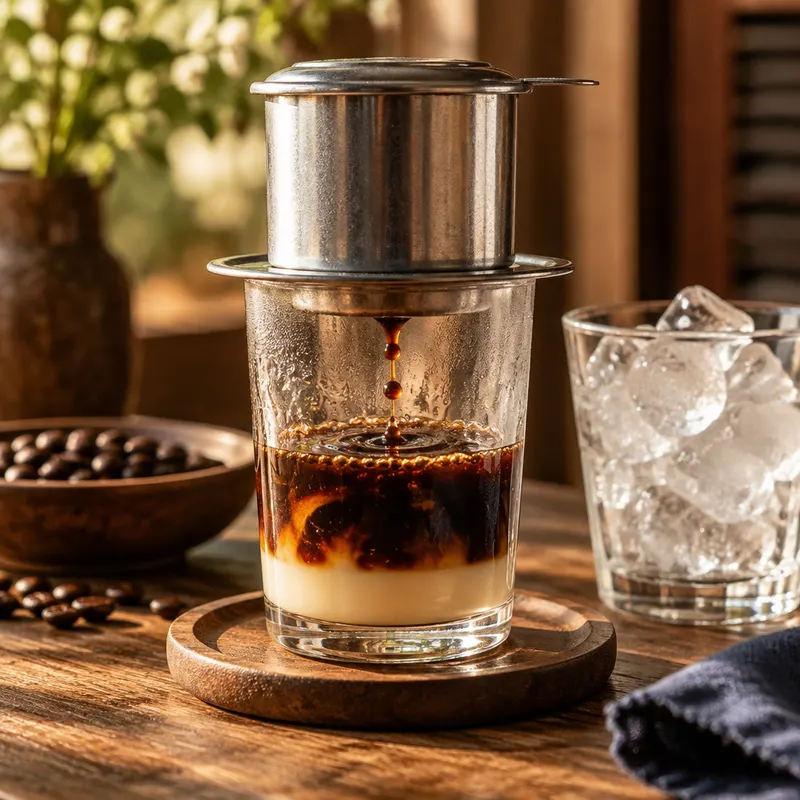
This Vietnamese iced coffee recipe needs four things: dark ground coffee, hot water, sweetened condensed milk and ice. The coffee drips slowly through a small metal filter called a phin, straight onto the condensed milk. You stir the two together and pour them over ice. It takes about ten minutes, and most of that is waiting for the drip. Below you will find the basic recipe, how to use the phin, a table of how much coffee and water different sources use (they do not agree), what to do if you have no phin, and the other Vietnamese coffee drinks worth knowing.
What is cà phê sữa đá?
In Vietnam the drink is called cà phê sữa đá, which Ethnic Spoon translates word by word: cà phê is coffee, sữa is milk and đá is ice. Wikipedia describes it as hot water poured through a phin holding dark-roast robusta coffee, into a small cup with sweetened condensed milk already in it, then stirred and poured into a tall glass of ice. In the north it is also called cà phê nâu đá, “iced brown coffee”.
The condensed milk has a history. According to Wikipedia, the drink is believed to be an adaptation of the French cafe au lait. Fresh milk was scarce and spoiled quickly in the tropical heat, so shelf-stable condensed milk took its place. Dark-roast robusta, which tastes more bitter than most Arabica, was found to balance its sweetness, and the ice came from the hot climate.
Search for ca phe sua da and every Vietnamese coffee recipe comes back to the same three parts: very concentrated coffee, a lot of sweetness, and ice that slowly softens both.
Vietnamese iced coffee recipe: ingredients and steps
This is a simple Vietnamese iced coffee recipe for one glass, built from the versions at Taming of the Spoon, Podium Coffee Club, Trieu Dai Coffee and Brewing Coffee Manually.
Ingredients
- 20 grams of dark-roast ground coffee, about 2 slightly rounded tablespoons (Vietnamese or robusta-forward if you can find it)
- 100 to 150 ml of water, just off the boil
- 2 tablespoons of sweetened condensed milk (1 for less sweet, 3 or more for very sweet)
- A glass full of ice
Equipment: a phin, a small heatproof glass, and a second, taller glass for the ice.
Steps
- Heat the water. Bring it just to the boil, then let it sit for a moment. Podium Coffee Club suggests about 90 to 95°C, and Copper Cow Coffee 190 to 205°F, which is about the same range.
- Add the milk to the glass. Spoon the condensed milk into the small heatproof glass. The coffee will drip down onto it.
- Fill the phin. Take out the filter press, add the coffee, and give the phin a light shake so the bed is level. Put the press back on top of the grounds and set the phin on the glass.
- Bloom. Pour in a small splash of hot water, about 30 ml, and wait about 30 seconds while the grounds swell.
- Fill and cover. Pour in the rest of the water, put on the lid and leave it alone. The drip usually takes about 4 to 6 minutes.
- Stir. When the dripping stops, lift off the phin (set it on its upturned lid) and stir until the coffee and condensed milk are fully mixed. Merakitech calls this the detail that matters: the milk should dissolve into the hot coffee before it meets the ice.
- Pour over ice. Pour into the tall glass of ice, stir again and serve.
If you would rather have one glass, use a large heatproof glass of 12 to 14 ounces and add the ice straight to it, as Taming of the Spoon suggests.
How to use a phin filter
A phin has four parts. Podium Coffee Club lists them as the plate that sits on the cup rim, the chamber that holds the coffee, the filter disc (or “gravity press”) that sits on the grounds, and the lid. Taming of the Spoon adds that the lid doubles as a drip tray: flip it over and set the phin on it when the coffee is done. Phins are usually aluminum or stainless steel, they need no paper filter, and the 4-ounce size is the most common.
How to use a phin filter comes down to three things:
- The press. Rest it on the grounds; do not crush them. Trieu Dai Coffee warns that pressing too firmly restricts the water flow. Some presses screw onto a center post, which lets you tighten them a little to slow the drip.
- The bloom. A small splash of water first, then a short wait. Sources wait 30 seconds (Podium Coffee Club, Trieu Dai Coffee, Brewing Coffee Manually), 45 seconds (Nguyen Coffee Supply) or 60 seconds (Copper Cow Coffee).
- The wait. Keep the lid on. Nguyen Coffee Supply expects the first drop before 2 minutes and the last drop around 5 minutes.
Vietnamese coffee ratio: what the sources say
There is no standard Vietnamese coffee ratio. The phin brews a small, concentrated cup, and each source sets its own dose, water and grind:
| Source | Coffee | Water | Grind | Drip time |
|---|---|---|---|---|
| Nguyen Coffee Supply | 14 g (2 tbsp) | not given; 1 oz to bloom | fine, like sand | about 5 min |
| Copper Cow Coffee | about 14 g (2 tbsp) | about 4 oz | medium-fine | 3 to 5 min |
| Taming of the Spoon | 2 rounded tbsp | 3/4 cup | not given | 4 to 7 min |
| Trieu Dai Coffee | 20 g | 120 to 140 ml | fine to extra-fine | 4 to 6 min |
| Podium Coffee Club | 20 to 25 g | 100 to 150 ml | medium-coarse to medium | 5 to 8 min |
| Brewing Coffee Manually | 20 g | 160 g | coarse, French press size | about 5 min |
Two things stand out. First, the range is wide: about 14 to 25 grams of coffee, about 100 to 160 ml of water, and a drip of about 3 to 8 minutes. Podium Coffee Club puts its version at roughly 1:5 to 1:6, which it calls much stronger than a pour-over or French press at about 1:15. Second, the grind advice points in opposite directions, from “fine like sand” (Nguyen Coffee Supply) to “French press” coarse (Brewing Coffee Manually). Our suggestion: use pre-ground Vietnamese coffee if you have it, which Podium Coffee Club says is usually the right grind for a phin, and let the drip time tell you whether to go finer or coarser next time.
How to make Vietnamese coffee without a phin
You do not need a phin. Ethnic Spoon and Taming of the Spoon both say a French press, a moka pot, an espresso machine or a drip machine can make the coffee; what matters is that it is brewed strong enough to stand up to the condensed milk and the melting ice. Here is how to make Vietnamese coffee with what you already own:
- French press. Brewing Coffee Manually uses a 1:8 coffee to water ratio, steeps for 4 minutes, then pours the coffee over 30 to 35 grams of condensed milk. Our French press guide covers the plunge.
- Pour-over cone (a batch for four). NYT Cooking steeps 1 cup of finely ground dark roast in 3 cups of boiling water for 5 minutes, pours it through a paper filter, and stirs in 1/2 cup of condensed milk. The recipe makes about 2 cups of coffee and keeps, covered, up to 3 days in the fridge.
- Drip machine (a batch for four). Allrecipes brews 1/2 cup of dark-roast coffee with 4 cups of water, then stirs 2 tablespoons of condensed milk into each 1-cup serving before it goes over ice.
- Espresso or moka pot. Both give the small, intense coffee the drink wants. Brew, stir into the milk while hot, then pour over ice.
- Cold brew. Brewing Coffee Manually suggests 1:8 and 12 to 24 hours, then condensed milk to taste. Our cold brew recipe has the method.
Batch versions are handy for a crowd, but they are not a phin: taste the coffee before the ice goes in, and use less water next time if it seems thin. Any of these turns into a Vietnamese iced coffee recipe once the condensed milk and the ice are in.
When the drip is too fast or too slow
Two sources agree on the fixes, so these are safe starting points:
- The drip stalls or takes much longer than 8 minutes. The press is too tight or the grind is too fine. Loosen the press or use a slightly coarser grind (Podium Coffee Club; Brewing Coffee Manually).
- Water rushes through in 2 to 3 minutes and the coffee tastes thin. The press is too loose or the grind is too coarse. Press a little more firmly next time, or go finer (Podium Coffee Club).
- The glass tastes too sweet at the bottom. The condensed milk was not fully mixed. Stir before the ice and again after, as JoEllen at Cuppacocoa and Merakitech both point out.
Which coffee to use
Wikipedia lists dark-roast robusta as the classic choice, and Merakitech describes robusta as heavier and more bitter than Arabica, with earthy and nutty notes that hold up to ice and condensed milk. Vietnam is the world’s largest robusta producer, according to Podium Coffee Club, citing International Coffee Organization data.
The coffee is the one place where a Vietnamese iced coffee recipe can taste very different from one kitchen to the next. If you cannot find Vietnamese coffee, Taming of the Spoon says any dark roast, such as a French roast, can work, and many US recipes use a chicory blend. Podium Coffee Club adds that specialty Arabica makes a more complex cup that may taste less like the coffee you know from a Vietnamese restaurant. Both are fine; it depends on the taste you are after.
Use sweetened condensed milk, not evaporated milk. Cuppacocoa points out that the two cans sit side by side in the store but are not interchangeable: condensed milk is thick and very sweet, evaporated milk tastes more like rich milk.
Other Vietnamese coffee drinks to try
Once you have the base, the same phin coffee opens a whole family of drinks (Wikipedia, unless noted):
- Cà phê đen đá: black coffee over ice, no milk.
- Cà phê sữa nóng: the hot version, condensed milk and coffee without ice (Merakitech).
- Bac xiu: Saigon-style “white coffee”, mostly condensed milk and fresh milk with a small amount of coffee, which Wikipedia compares to a latte macchiato.
- Vietnamese egg coffee (cà phê trứng): coffee topped with a custard-like foam of whipped egg yolks and condensed milk, created in Hanoi in 1946 during a milk shortage.
- Coconut coffee: coffee over a slushy of condensed milk, coconut cream and ice.
- Salt coffee (cà phê muối): coffee and condensed milk under a salted cream foam, first made in Huế in 2010.
For how these compare with the drinks you already know, see our types of coffee drinks guide or the Coffee Atlas.
Questions people ask
What is Vietnamese iced coffee made of?
Three ingredients plus ice: dark ground coffee (often robusta), hot water and sweetened condensed milk. The coffee is dripped through a phin onto the milk, stirred and poured over ice.
Can you make Vietnamese iced coffee without a phin?
Yes. Ethnic Spoon and Taming of the Spoon both use a French press, moka pot or espresso as a stand-in. Brew it concentrated, stir in the condensed milk while the coffee is hot, then pour over ice. NYT Cooking makes a batch with a pour-over cone.
What coffee is best for Vietnamese iced coffee?
A dark-roast robusta or a Vietnamese blend is the traditional choice (Wikipedia). A French roast or a chicory blend is a common substitute when Vietnamese coffee is hard to find.
How is Vietnamese iced coffee different from regular iced coffee?
Regular iced coffee is usually drip coffee over ice with milk or sugar if you want it. This Vietnamese iced coffee recipe uses a much more concentrated brew, often robusta, and condensed milk, so the drink is thicker and sweeter (Ethnic Spoon). Our cold brew vs iced coffee guide compares the two most common American versions.
The short version
A Vietnamese iced coffee recipe is easy to remember: about 20 grams of dark coffee in a phin, 100 to 150 ml of water just off the boil, a 30-second bloom, a slow drip onto 2 tablespoons of condensed milk, a good stir, then ice. If your drip is fast and thin, press a little firmer or grind finer; if it stalls, loosen the press. And if you have no phin, any brewer that makes very concentrated coffee will get you most of the way there.
Sources
- Wikipedia. Vietnamese iced coffee.
- Taming of the Spoon (Nguyet Vo). Vietnamese Iced Coffee.
- Nguyen Coffee Supply. Traditional Vietnamese Drip (Phin) brew guide.
- Copper Cow Coffee. How to Use a Phin.
- Podium Coffee Club. Vietnamese Phin Coffee Guide.
- Trieu Dai Coffee. How to Brew Vietnamese Coffee at Home Using a Phin Filter.
- Brewing Coffee Manually (John). Vietnamese Iced Coffee.
- NYT Cooking (Kay Chun). Vietnamese Iced Coffee.
- Allrecipes. Vietnamese Iced Coffee.
- Ethnic Spoon (Analida). Vietnamese Iced Coffee (Ca Phe Sua Da).
- Merakitech. Vietnamese Coffee for Espresso: Robusta Power and Sweet Condensed Milk.
- Cuppacocoa (JoEllen). Vietnamese Iced Coffee Recipe.