The pour over coffee ratio is the one number that decides most of how your cup tastes. It tells you how much ground coffee to use for a given amount of water, and once you know it, you can brew one small cup or a full carafe without guessing. The short answer: start at about 1:16, which means 1 gram of coffee for every 16 grams of water, then adjust to taste.
This guide gives you a ratio chart for common cup sizes, a simple base recipe, the grind, water and bloom details, and quick fixes when the cup tastes off.
Pour over coffee ratio: the short answer
- Start at 1:16. For every gram of coffee, pour 16 grams of water. Seattle Coffee Gear calls this a reliable place to start for drip and pour-over.
- Stay roughly between 1:15 and 1:17. A lower second number gives a stronger cup; a higher one gives a lighter cup.
- Weigh, do not scoop. A kitchen scale that reads to the nearest gram is enough.
- For a 12 oz mug: about 21 g of coffee and 340 g of water (Seattle Coffee Gear).
Water is handy here: 1 gram of water is about 1 milliliter, so 340 g of water is about 340 ml.
What is a coffee to water ratio?
A coffee to water ratio compares the weight of the dry coffee with the weight of the water you brew it with. It is written as 1:x. Counter Culture Coffee explains it simply: the 1 is one gram of coffee, and x is the number of grams of water. So 1:16 means 16 grams of water per gram of coffee.
The point of a ratio, rather than a fixed recipe, is that it scales. Counter Culture notes that a ratio lets you brew as much or as little as you want and still get the same flavor balance. If you like your 12 oz mug at 1:16, you can make 24 oz at 1:16 too, simply by doubling both numbers.
Is there a golden ratio for pour over?
There is no single official number, and the sources do not fully agree. That is normal: taste is personal, and the range is narrow.
| Source | Suggested ratio | Notes |
|---|---|---|
| AboutCoffee.org (National Coffee Association) | 1:13 to 1:16 | Pour-over page, measured in grams |
| Seattle Coffee Gear | Start at 1:16; 1:15 to 1:17 | For drip and pour over |
| Counter Culture Coffee | 1:17 | Its broad standard for pour-over and drip |
| SCA Golden Cup (via Methodical Coffee) | About 55 g per liter (about 1:18) | Developed for batch brewing |
The phrase “golden ratio” often points to the Specialty Coffee Association’s Golden Cup standard. Methodical Coffee explains that it was built for batch brewers in coffee shops, at about 55 grams of coffee per liter of water, and that newer SCA-funded research sees flavor as a matter of taste. For a single cup at home, 1:16 sits in the middle of the published range, which is why so many guides start there.
Pour over coffee ratio chart
A pour over coffee ratio of 1:16 gives the amounts below. The 12 oz row is from Seattle Coffee Gear; the others are from the French Press & Co. ratio chart, which rounds to easy numbers.
| Cup size | Coffee | Water | Approx. tablespoons (no scale) |
|---|---|---|---|
| Small cup, 8 oz | 15 g | 240 g | 2 |
| Mug, 12 oz | 21 g | 340 g | 3 |
| Travel mug, 16 oz | 30 g | 480 g | 4 |
| Two mugs, 24 oz | 45 g | 720 g | 6 |
The tablespoon column uses Counter Culture’s rule of 1 tablespoon of coffee for every 4 ounces of water. Use it as a rough guide: Seattle Coffee Gear notes that one tablespoon can weigh anywhere from 4 to 8 grams, depending on the bean and the grind.
How much water for 1 cup of pour over coffee?
For an 8 oz cup, use about 240 g of water with 15 g of coffee. Note that “cup” is not a fixed size in coffee. The National Coffee Association’s drip guide counts a cup as 6 ounces, and recommends 1 to 2 tablespoons of ground coffee for every 6 ounces of water. Check what your own mug holds and use the chart above.
How much coffee to use for a 12 oz pour over?
About 21 g of coffee with 340 g of water, which is the 1:16 starting point Seattle Coffee Gear gives for a standard 12 oz mug. Without a scale, that is about 3 tablespoons.
How many tablespoons of coffee for 16 oz of water pour over?
About 4 tablespoons, using Counter Culture’s rule of 1 tablespoon per 4 ounces. On a scale, the French Press & Co. chart uses 30 g of coffee for 480 g of water.
How to make 2 cups of coffee pour over?
Double the base recipe: 45 g of coffee and 720 g of water fills two mugs at 1:16. Use a larger dripper or carafe so the bed of grounds and the water fit. French Press & Co. suggests a slightly coarser grind as the batch grows, because more water takes longer to flow through a deeper bed of coffee.
How to make pour over coffee, step by step
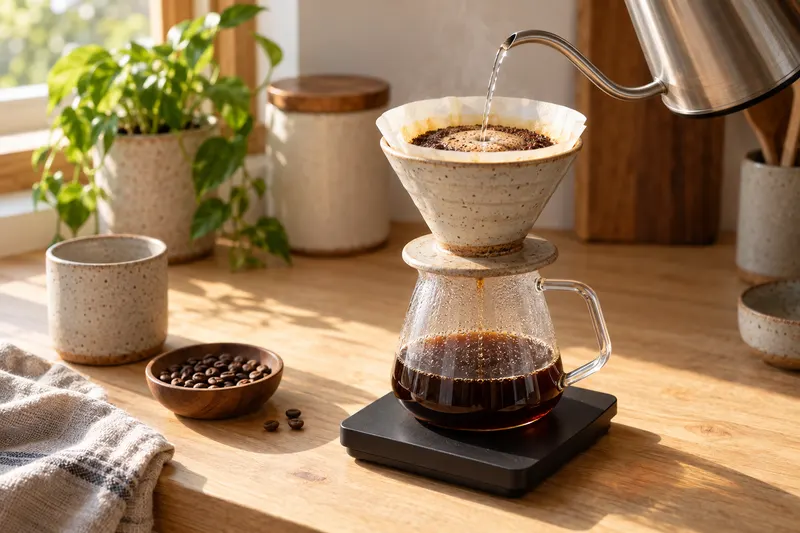
This is the base pour over coffee recipe for one 12 oz mug. It uses 21 g of coffee and 340 g of water, a 1:16 ratio.
You need: a dripper (a cone like the V60, or a flat-bottom dripper), a paper filter, a kettle (a gooseneck gives the most control), a kitchen scale, a timer, and a grinder or pre-ground coffee.
- Heat the water to about 195 to 205°F (90 to 96°C). Without a thermometer, Alton Brown’s tip is to bring the water to a boil and let it rest off the heat for about 30 seconds.
- Rinse the filter. Put the paper filter in the dripper over your mug or carafe and pour hot water through it. Coffee Bros notes that this removes the papery taste and warms the brewer. Pour that water away.
- Add the coffee. Add 21 g of medium-ground coffee, shake the dripper gently so the bed is level, and set the scale to zero.
- Bloom. Start a timer and pour about 42 g of water, double the weight of the coffee, so every ground is wet. Wait 30 to 45 seconds.
- Pour in stages. Pour the rest slowly, in small circles from the center outward, until the scale reads 340 g. Avoid pouring straight onto the paper at the edge, where water can run past the coffee.
- Let it drain. Coffee Bros aims for a total brew time of roughly 3 minutes. If it is much faster or slower, change the grind next time.
- Serve. Remove the dripper, give the coffee a swirl and pour.
What the bloom does
The first small pour is called the bloom. Fresh coffee still holds carbon dioxide from roasting, and hot water releases it, so the grounds puff up and bubble. French Press & Co. explains that if you pour all the water at once, the gas pushes water away from the grounds and the coffee extracts unevenly. Its rule is to bloom with about double the coffee’s weight in water; Espresso Parts suggests waiting about 30 to 45 seconds. A flat bloom with few bubbles often means the beans are not very fresh.
Pour over coffee grind size and water temperature
The ratio works only together with the grind and the water. These two settings decide how fast the water flows and how much flavor it pulls out.
Pour over coffee grind size
Use a medium grind to start. The National Coffee Association compares the medium drip grind to kosher salt, and suggests starting medium and adjusting from there. Coffee Bros prefers a slightly coarser medium-coarse setting for its V60 and Kalita recipe. The general rule from the NCA: the longer the coffee and water stay in contact, the coarser the grind should be. A burr grinder gives the most even particles, which Espresso Parts calls the most important thing about the grind.
Pour over coffee water temperature
Aim for about 195 to 205°F (90 to 96°C). The AboutCoffee.org pour-over page gives 93 ± 3°C, citing an SCA standard, and Espresso Parts gives the same 195 to 205°F range. Water straight off a rolling boil is a little too hot, and water well below the range can taste flat and sour.
How long should pour over take?
The NCA’s pour-over page gives 2 to 4 minutes of contact between coffee and water. Alton Brown’s larger 420 g recipe takes about 3 to 3 and a half minutes. If yours drains in under 2 minutes, grind finer; if it stalls well past 4, grind coarser.
Adjusting the ratio: quick fixes
When you adjust your pour over coffee ratio, change one thing at a time, so you know what made the difference. Seattle Coffee Gear advises keeping the grind the same while you adjust the ratio.
| The cup tastes | Likely cause | Try this |
|---|---|---|
| Weak, thin or watery | Too much water for the coffee | Use a little more coffee, for example 1:15 |
| Too strong or heavy | Too little water for the coffee | Use a little more water, for example 1:17 |
| Sour, not full-flavored | Under-extracted, often grind too coarse | Grind slightly finer (Alton Brown) |
| Bitter or harsh | Over-extracted, often grind too fine | Grind slightly coarser (Alton Brown) |
| Drains very fast | Grind too coarse | Grind finer |
| Drains very slowly or stalls | Grind too fine, or a large batch | Grind coarser |
Seattle Coffee Gear notes that a gram or two in either direction makes a noticeable difference, so small steps are enough.
Pour over without a scale
You can brew pour over coffee without a scale, but it is less consistent. Use Counter Culture’s rule of 1 tablespoon of ground coffee per 4 ounces of water, and measure the water with a measuring cup. The NCA’s drip rule of 1 to 2 tablespoons per 6 ounces gives a similar range. Because a tablespoon of coffee varies from about 4 to 8 grams, the same scoop of a light roast and a dark roast can give different cups. If you brew most days, a basic kitchen scale is the simplest upgrade.
Iced pour over coffee
Iced pour over coffee (also called flash brew or Japanese iced coffee) is brewed hot straight onto ice. Keep the same pour over coffee ratio, but swap about half the water for ice in the carafe. Peet’s Coffee describes it as 8 parts hot water and 8 parts ice for a 1:16 brew.
For one glass with the base recipe: put about 170 g of ice in the carafe, then brew 21 g of coffee with about 170 g of hot water, using the same steps as above. The ice melts as the coffee drips onto it and cools it quickly. Pour over fresh ice to serve. Because less hot water passes through the grounds, a slightly finer grind can help keep the flavor full. For other cold methods, see how to make iced coffee at home and cold brew vs iced coffee.
Pour over vs other brewing methods
Pour-over is a drip method: water flows through the grounds and out of the filter. Immersion methods steep the coffee in the water for the whole brew. Counter Culture explains that immersion brewers such as the French press need a tighter ratio, closer to 1:15, because all the water sits with all the coffee for the full brew time.
| Method | How it brews | Typical starting ratio | Grind |
|---|---|---|---|
| Pour-over | Water flows through a paper filter | About 1:16 | Medium |
| French press | Coffee steeps, then a mesh filter | About 1:15 | Coarse |
| Espresso | Pressure, a fine grind and about 1:2 | About 1:2 | Fine |
The paper filter holds back most oils and fine particles, which is why pour-over coffee tastes clean and light-bodied. For a heavier cup, see how to make French press coffee; for a strong stovetop brew, see how to use a moka pot. If you are wondering how filter coffee compares with a shot, read espresso vs coffee. Pour-over also makes a good base for a cafe au lait, and you can find every drink and method in the Coffee Atlas.
The bottom line
Start at 1:16, weigh the coffee and the water, use a medium grind and water just off the boil, and bloom before the main pour. Taste, then change one thing at a time: more coffee for a stronger cup, more water for a lighter one, a finer grind for sour, a coarser grind for bitter. After a few mornings, you will know your own pour over coffee ratio.
Sources
- AboutCoffee.org (National Coffee Association). Pour-over coffee.
- AboutCoffee.org (National Coffee Association). Drip coffee.
- Counter Culture Coffee. Coffee Basics: Brewing Ratios.
- Seattle Coffee Gear. Coffee to Water Ratios: A Simple Guide.
- Methodical Coffee. Coffee-to-Water Ratio: The Ultimate Guide to Brewing Ratios.
- French Press & Co. Pour Over Coffee Ratio.
- Coffee Bros. Pour Over Brew Guide.
- Espresso Parts. How to Make the Perfect Pour Over Coffee.
- Alton Brown. Perfect Pour Over Coffee.
- Peet's Coffee. What's the Difference Between Cold Brew and Iced Coffee?