This guide shows you how to make Turkish coffee at home the traditional way. You need powder-fine coffee, cold water, a small long-handled pot and a few minutes of patience. Sugar is optional, but it goes in at the start, not at the end. Below you will find what Turkish coffee is, the gear, a step-by-step method, a ratio chart from five brewing guides, how to get a thick foam, how to serve it, and what to do if you do not own the traditional pot.
What is Turkish coffee?
So, what is Turkish coffee? It is a way of brewing, not a type of bean or a country of origin. Foolproof Living (Aysegul Sanford, who grew up in Türkiye and once served it in an Istanbul hotel lobby) puts it simply: what makes it Turkish is the brewing method, not the bean. The coffee is usually Arabica, ground to an extremely fine powder, and it is never filtered out.
The ground coffee, cold water and sugar go into the pot together and are heated slowly until a dark foam rises. The coffee is then poured, grounds and all, into small cups. The grounds sink to the bottom while you sip, which is why the drink feels thick and full-bodied.
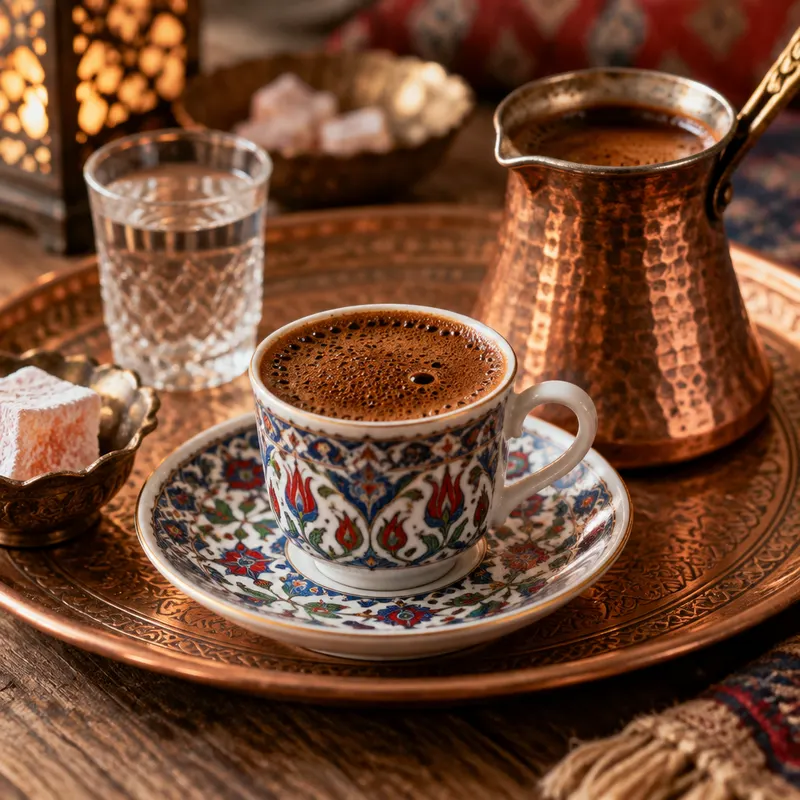
UNESCO added “Turkish coffee culture and tradition” to its Representative List of the Intangible Cultural Heritage of Humanity in 2013. The listing describes freshly roasted beans ground to a fine powder, brewed slowly on a stove with cold water and sugar to produce the desired foam, and served in small cups with a glass of water. It also calls the tradition a symbol of hospitality and friendship.
What you need to make Turkish coffee
You need very little equipment:
- A cezve. The small pot with a long handle, pronounced roughly “jez-veh”. It is usually copper or stainless steel. Cooking Gorgeous notes that copper heats up and cools down fast, which gives you more control at the moment the coffee is about to rise.
- Turkish coffee. Coffee ground finer than espresso, so fine it feels like flour between your fingers (Copenhagen Coffee Lab). Most guides suggest buying it pre-ground, because many home grinders cannot go that fine.
- Cold water. Fresh, cold, filtered if you like.
- Sugar (optional). Plain granulated sugar is the traditional choice, according to Foolproof Living. Peace Coffee uses unrefined cane sugar.
- Small cups. Turkish coffee cups, or espresso cups in a pinch.
- A glass of water per guest. It is part of the serving, not an extra.
Cezve vs ibrik: are they the same pot?
You will see both names in recipes, and the sources do not fully agree. Cooking Gorgeous and Copenhagen Coffee Lab use them as two names for the same pot: cezve is the Turkish word, and ibrik is used in Arabic, Greek and other parts of the region. Foolproof Living says they are technically different tools: a cezve has a wide bottom for brewing, while an ibrik has a narrower bottom and a long neck and is mostly used for serving. If you are shopping for a pot to brew in, look for the wide-bottomed shape.
How to make Turkish coffee step by step
This is the method most of the guides we read agree on. It makes 2 small cups.
- Ask about sugar first. Decide how sweet each cup should be before you start. You cannot stir sugar in later without losing the foam.
- Measure the water with the serving cup. Fill one serving cup with cold water per person and pour it into the pot. Using the cup you will serve in keeps the portions right (Cooking Gorgeous).
- Add the coffee and sugar. Add about 1 heaping teaspoon of Turkish coffee per cup, plus sugar to taste.
- Stir once, while it is cold. Stir briefly until the coffee is wet and the sugar is mixed in. Then put the spoon down. This is the only stir.
- Heat slowly. Put the pot on low to medium heat. After a couple of minutes a dark foam starts to form around the edge and then across the top.
- Share the foam. When the foam rises and the coffee is close to boiling, take the pot off the heat and spoon or pour a little foam into each cup.
- Let it rise again. Put the pot back on the heat. When it rises a second time, take it off and pour slowly into the cups, filling each to the rim without breaking the foam.
- Wait, then sip. Let the cups sit for about 30 seconds so the grounds can settle (Foolproof Living). Serve with water.
That is how to make Turkish coffee in its simplest form. The whole thing takes about 5 to 8 minutes. Mehmet Efendi, one of the oldest Turkish coffee brands, says the brewing itself only takes about two minutes.
Turkish coffee ratio: how much coffee per cup?
The guides do not use the same amounts: some use a teaspoon, some a tablespoon, some a scale.
| Guide | Water | Coffee | Note |
|---|---|---|---|
| Mehmet Efendi | 1 coffee cup | 1 teaspoon (6 g) | Sugar if needed |
| Cooking Gorgeous | 1 serving cup | 1 heaping teaspoon | Stir only before heating |
| Copenhagen Coffee Lab | About 70 ml per cup | About 1 tablespoon | Low heat, no stirring once it is on the stove |
| Foolproof Living | 1 1/2 coffee cups per serving | 1 heaping tablespoon per serving | Spoons foam into the cups first |
| Peace Coffee | 350 ml (12 fl oz) | 30 g, about 1 part coffee to 12 parts water | Batch for a 16 oz pot |
A heaping teaspoon per small cup is a safe place to begin. If it tastes thin, move toward a tablespoon. Peace Coffee’s 1 to 12 ratio is useful if you have a scale and want repeatable results.
What is the coffee to water ratio for Turkish coffee?
There is no single fixed ratio. Mehmet Efendi uses about 6 g of coffee per small cup of water, and Peace Coffee prefers 1 part coffee to 12 parts water by weight. Most home cooks simply use 1 heaping teaspoon per cup and adjust from there.
Is sugar added to Turkish coffee?
Yes, if you want it sweet, and it is added at the beginning. The sugar goes into the cold water with the coffee and dissolves as it heats. In Türkiye, the host usually asks how you take it before brewing. These are the four common levels:
| Turkish name | Meaning | Cooking Gorgeous | Foolproof Living |
|---|---|---|---|
| Sade | No sugar | 0 | 0 |
| Az şekerli | A little sugar | 1/2 teaspoon | About 1 teaspoon |
| Orta | Medium sweet | 1 teaspoon | 1 to 2 teaspoons |
| Şekerli | Sweet | 2 teaspoons | 3 to 4 teaspoons |
The two guides differ on how much “sweet” means, so taste and adjust. If two guests want different sugar levels, Foolproof Living starts without sugar, fills the plain cup first, then adds sugar to what is left in the pot and brings it up once more for the second cup.
How to get a thick foam on Turkish coffee
The foam is the sign of a well-made cup. Once you know how to make Turkish coffee, the foam comes down to a few habits:
- Do not stir after heating. Foolproof Living calls stirring too much the most common mistake.
- Go slow. Low heat gives the foam time to build. Copenhagen Coffee Lab says it is better to take the pot off a moment too early than too late, because hard boiling makes the foam disappear.
- Use a fine enough grind. Coarse coffee gives a thin, gritty cup and little foam.
- Start with cold water. Cooking Gorgeous lists cold water as the first tip.
- Do not overfill. Small batches of 1 or 2 cups are easier. Foolproof Living suggests beginners make no more than 2 cups at a time.
If the foam is gone, it is hard to bring it back. Serve it anyway, and put the spoon down earlier next time (Foolproof Living).
How to drink Turkish coffee
Knowing how to drink Turkish coffee is part of the experience:
- Sip the water first. It clears your palate so the first sip of coffee tastes clean.
- Let the grounds settle. Wait about 30 seconds to a minute before drinking.
- Sip slowly. It is a drink to sit with, often with something sweet on the side, such as Turkish delight (lokum) or a piece of chocolate.
- Stop before the bottom. The thick layer of grounds at the bottom is not meant to be drunk.
- One cup is usually enough. Because it is so concentrated, a second cup is rarely offered, according to Cooking Gorgeous and Foolproof Living.
Turkish coffee is usually served black. Foolproof Living says she never saw milk added while growing up in Türkiye, while Cooking Gorgeous mentions milk as a non-traditional variation some people enjoy.
How to serve Turkish coffee to guests
Serving is part of the tradition. A few customs from the guides:
- Serve the eldest guest first, as a sign of respect.
- Turn the cup’s handle toward the guest so it is easy to pick up.
- Put a glass of water and something sweet next to every cup.
UNESCO notes that the coffee is mainly shared in coffee-houses and homes where people meet to talk, and that it plays a role in engagement ceremonies and holidays.
Turkish coffee fortune reading
After the cup is finished, a muddy layer of grounds remains. In Türkiye this is used for kahve falı, coffee fortune reading. UNESCO notes that the grounds left in the empty cup are often used to tell a person’s fortune. Foolproof Living describes the steps: turn the cup slowly upside down onto the saucer, away from yourself, let it cool, and then someone reads the shapes the grounds leave inside the cup.
Turkish coffee vs espresso and other brewing methods
Turkish coffee vs espresso is the comparison most people make first, since both are strong and served in small cups. The difference is in how the water meets the coffee. Copenhagen Coffee Lab sums up the main methods like this:
| Method | Grind | Filter | What you get |
|---|---|---|---|
| Turkish coffee | Extremely fine, like powder | None | Full-bodied, intense, grounds at the bottom |
| Espresso | Fine | Pressure through a basket | Concentrated and creamy |
| French press | Coarse | Metal mesh | Full-bodied, a little sediment |
| Pour-over | Medium | Paper | Clean and light |
Espresso is forced through the coffee under pressure in a machine and is filtered. Turkish coffee is heated slowly with no pressure and no filter. Foolproof Living adds that sugar goes into Turkish coffee while it brews, while espresso is sweetened in the cup. If you like the small, strong cup but want milk, a cortado or a latte starts from espresso instead.
Is Turkish coffee the same as Greek coffee?
Mostly, yes. Foolproof Living calls them essentially the same drink: the same brewing method, the same fine coffee and the same kind of pot, called a briki in Greek. Cooking Gorgeous says Greek coffee is very similar but may differ slightly in sugar levels or foam style. Similar boiled coffee traditions exist across the Middle East and the Balkans (Copenhagen Coffee Lab), and some regions add cardamom.
How do you make Turkish coffee without a cezve?
Use the smallest saucepan you have. Cooking Gorgeous, Copenhagen Coffee Lab and Peace Coffee all say a small pan works, and Peace Coffee mentions that narrow camping cookware is a good stand-in. Foolproof Living warns that a wide-bottomed cezve makes the thick foam much easier, so expect less of it in a regular pan. Keep the heat low, use the same amounts, and pour slowly so the grounds stay behind.
An electric Turkish coffee maker is another option. Foolproof Living says most people in Türkiye now use one, and that it brews a cup in less than 3 minutes. The classic stovetop method still needs no machine at all.
Turkish coffee variations
Once you know the basic turkish coffee recipe, a few small changes are common:
- With cardamom. Cooking Gorgeous notes that cardamom is common in the Middle East for a warm, spiced note. Peace Coffee adds a pinch, about 1/4 teaspoon, per serving, and also lists cinnamon and allspice.
- Stronger cup. Copenhagen Coffee Lab lets the coffee foam up one more time for a stronger result.
- With milk. Not traditional in Türkiye, but some people like it that way (Cooking Gorgeous).
For other drinks, see the Coffee Atlas or Arabic coffee.
Common problems and fixes
| Problem | Likely cause | What to try |
|---|---|---|
| No foam | Stirred after heating, or heat too high | Stir only once while cold, use low heat |
| Boiled over | Left on the heat too long | Take it off as soon as the foam rises |
| Thin, watery cup | Too little coffee or a coarse grind | Use a heaping spoonful per cup and powder-fine coffee |
| Gritty mouthfeel | Drinking too soon or too far down | Wait about 30 seconds, and stop before the bottom layer |
| Too sweet or not sweet enough | Sugar guessed after brewing | Decide the sugar level before you start |
| Bitter taste | Hard boiling | Keep it at a gentle rise, not a rolling boil |
Turkish coffee: quick checklist
To sum up how to make Turkish coffee: measure one small cup of cold water per person into a cezve or small pan, add about 1 heaping teaspoon of powder-fine coffee and sugar to taste, stir once, and heat slowly. Spoon the foam into the cups as it rises, bring it up once more, and pour gently. Serve with a glass of water and something sweet, wait for the grounds to settle, and leave the last sip in the cup.
Sources
- Foolproof Living (Aysegul Sanford). Turkish Coffee: How to Make It, Serve It, and Read Your Fortune.
- Cooking Gorgeous (Ayla Clulee). How to Make Turkish Coffee.
- Kurukahveci Mehmet Efendi. Brew guide: Turkish coffee with cezve.
- Copenhagen Coffee Lab (Jonas Munch Schmidt-Andersen). Turkish coffee: how to brew it correctly.
- Peace Coffee. Brew guide: Turkish Coffee.
- UNESCO Intangible Cultural Heritage. Turkish coffee culture and tradition (inscribed 2013).