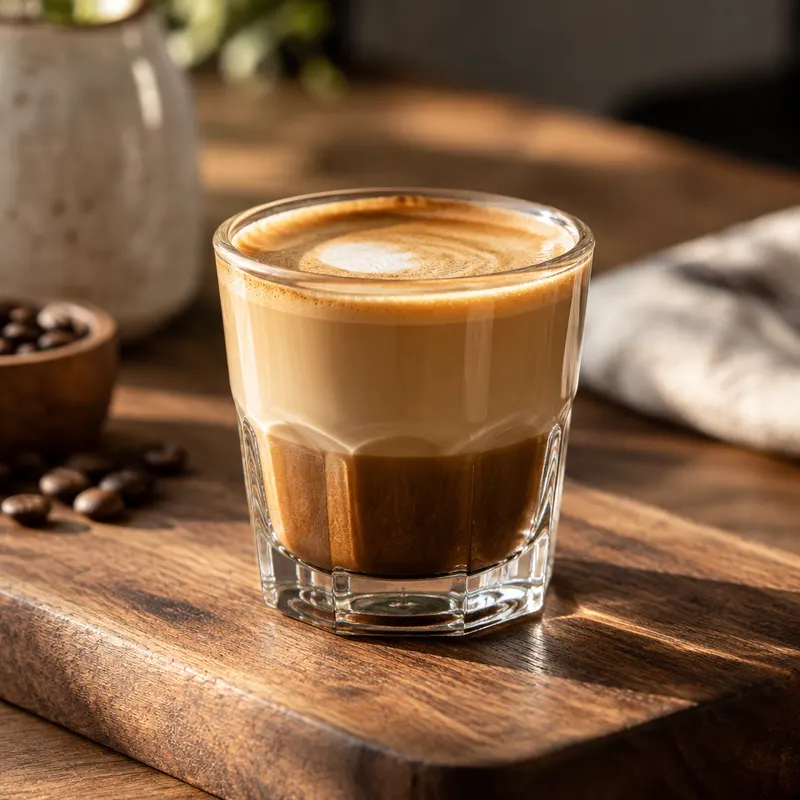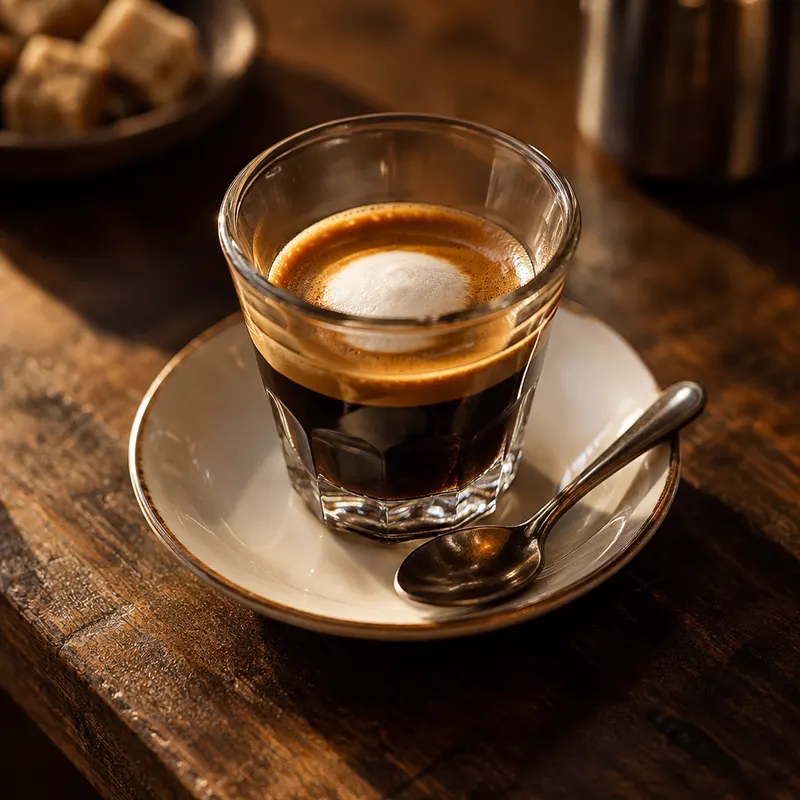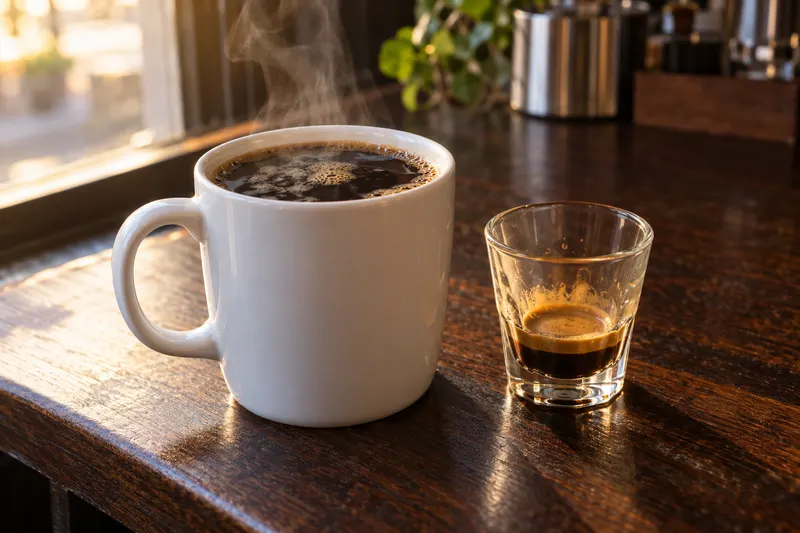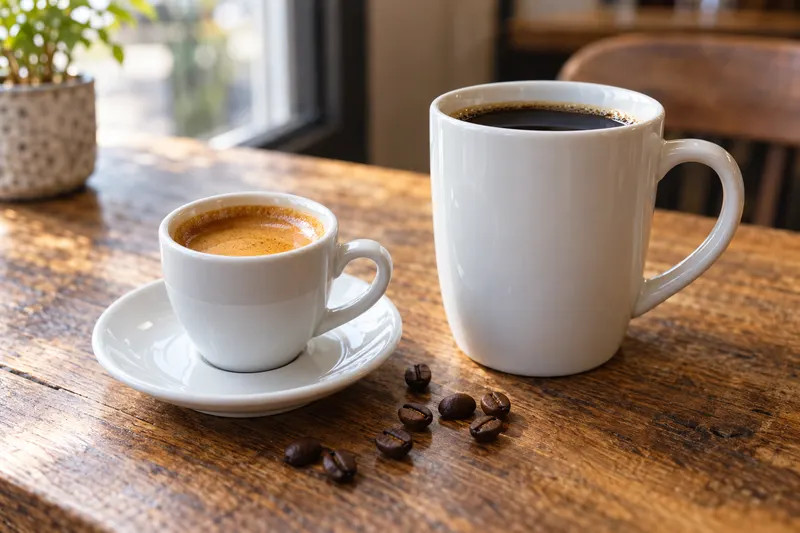
Espresso and a mug of drip coffee can start from the very same bag of beans, yet they taste like two different drinks. The espresso vs coffee question is really a question about brewing: how fine the grind is, how much water touches it, how long, and with how much force. Change those four things and the same coffee turns into a thick, intense shot or a lighter, larger cup.
This guide compares the two side by side: pressure, grind, ratio, brew time, taste, crema and beans. It also answers the questions people ask most, from “is espresso stronger?” to “can I use regular coffee in an espresso machine?” One note on scope: here, strength means flavor and concentration, not caffeine.
Espresso vs coffee at a glance
Meraki sums it up in one line: espresso is coffee, but not every coffee is espresso. Both are roasted coffee and hot water. The difference between espresso and coffee lies in the way the water meets the grounds.
| Espresso | Brewed coffee (drip, pour-over) | |
|---|---|---|
| How water moves | Pushed through under pressure | Flows through by gravity |
| Pressure | About 9 bar | No added pressure |
| Grind | Fine | Medium |
| Ratio (coffee to drink) | About 1:2 | About 1:15 to 1:17 |
| Brew time | About 20 to 30 seconds | About 3 to 5 minutes |
| Serving | About 1 to 2 oz | Usually 8 to 12 oz |
| Filter | Metal basket | Usually paper |
| Crema | Yes | No |
| Texture | Thick, syrupy | Lighter, cleaner |
Sources: Specialty Coffee Association (SCA), Meraki, Fellow, Canal Coffee Company. These are typical values, not fixed rules; recipes, grinders and machines vary.
Is espresso just coffee?
Yes. Espresso is not a separate plant, bean or roast. Wikipedia describes it as a concentrated form of coffee made by forcing hot water under high pressure through finely ground coffee. “Coffee” in everyday American speech usually means brewed coffee, the full mug from a drip machine, a pour-over cone or a French press. Espresso is one more way to brew the same ingredient.
That is why espresso vs coffee is best compared method by method. If you want the full background on the shot itself, see what is espresso.
Pressure: the biggest difference
The clearest line between the two is force. An espresso machine pushes hot water through a tightly packed puck of coffee. The classic industry definition, quoted by the SCA in its 25 Magazine, describes a 25 to 35 ml drink made from 7 to 9 g of coffee, with water at 195 to 205°F (90.5 to 96.1°C) forced through at 9 to 10 atmospheres in 20 to 30 seconds.
A drip brewer or pour-over cone adds no pressure at all. Fellow lists it as 0 bar against 9 bar for espresso: the water simply flows down through the grounds. A French press does not push either; the grounds steep, and the plunger only separates them from the liquid.
Pressure does more than speed things up. Meraki explains that, together with the fine grind and the small amount of water, it carries tiny particles and coffee oils into the cup. That is where espresso’s weight and texture come from, and it is the part of espresso vs coffee that no amount of strong drip coffee can copy.
Grind size: fine vs medium
Espresso needs a fine grind because the coffee has to resist the pressure. If the grounds are too coarse, Meraki notes, the water rushes through and the shot runs fast, thin and sour. Finer grounds slow the flow down.
Filter coffee uses a medium grind because gravity is gentle and the brew takes minutes. Put espresso-fine coffee in a drip brewer and the water may struggle to get through, giving a muddy, bitter cup. Put a filter grind in an espresso basket and the shot comes out weak. A French press goes coarser still; see how to make French press coffee for that recipe.
Ratio and brew time
The second big difference is how much water meets the coffee. A common modern espresso recipe, Meraki writes, uses about 18 g of ground coffee to make about 36 g of espresso, a 1:2 ratio. Filter coffee often uses around 60 g of coffee per liter of water, roughly 1:15 to 1:17.
Time follows the same pattern. A shot is done in seconds: Peet’s Coffee gives 25 to 30 seconds for about 1 ounce. Drip and pour-over take several minutes, and a French press steeps for minutes before plunging. Less water and less time, pushed hard, gives a small, dense drink; more water and more time, with no push, gives a large, lighter one.
Change only the ratio and you change the family of the drink. Run more water through the same dose and you get a lungo. Pull it shorter and you get a ristretto. Double the dose and you have a doppio.
Espresso vs drip coffee in the cup
Put a shot next to a mug and the contrast is easy to taste. Canal Coffee Company describes espresso as having a thicker mouthfeel and more natural coffee oils, while drip coffee is lighter, easier to drink, and lets the individual tasting notes stand out.
The filter is part of the reason. Fellow points out that espresso runs through a metal basket, so the oils stay in the cup, while the paper filter in a drip brewer holds some of them back. A French press also uses a metal filter, which is why it tastes fuller than pour-over.
Concentration does the rest. Black Oak Coffee Roasters explains that espresso holds everything in much higher concentration, the acidity and the bitterness included. A sharp, bright coffee becomes a very sharp shot; a bitter one becomes very bitter. Drip coffee is diluted, so the same coffee is easier to balance. This is the practical difference in the espresso vs drip coffee debate: espresso magnifies whatever is in the bean.
Crema
Crema, the golden-brown foam on a shot, needs pressure. Perfect Daily Grind explains that pressure lets the water hold more of the carbon dioxide left from roasting, which comes out as tiny bubbles in the cup. Drip and pour-over coffee do not form it. Fresh coffee tends to give more crema, but Meraki warns that crema alone is not a measure of a good shot; taste is.
What are the key differences between filter coffee and espresso?
In short: pressure, grind, ratio and time. Filter coffee is made by gravity with a medium grind, a lot of water and several minutes of contact, usually through paper. Espresso is made under about 9 bar with a fine grind, very little water and well under a minute, through metal. The result of espresso vs filter coffee is a small, thick, intense drink on one side and a large, clean, lighter cup on the other, even with identical beans.
Is espresso stronger than coffee?
Per sip, yes, in flavor and body. Espresso is far more concentrated, so each mouthful carries much more dissolved coffee than a mouthful of drip. But “stronger” is often used loosely. A mug of brewed coffee is many times larger than a shot, and Meraki notes that you can brew unusually strong filter coffee and it still will not have espresso’s texture. Strong drip coffee is not espresso, and a single shot is not simply a bigger version of a mug.
If you want espresso flavor in a bigger drink, the answer is dilution, which is what an Americano does.
What is the difference between coffee beans and espresso beans?
There is no botanical espresso bean. Meraki explains that a bag labeled “espresso” holds coffee beans roasted or blended to taste balanced under pressure; they are still coffee beans. The same coffee can be ground fine for a shot or medium for a drip machine. That is the honest answer to espresso beans vs coffee beans: the label describes the roaster’s intention, not a different ingredient.
The label does often mean a darker roast. Peet’s Coffee says roasters pick and roast espresso beans to bring out body, crema and sweetness under pressure, but that you can pull a shot with any roast if the grind, dose and extraction are right. Black Oak adds that many newer specialty roasters use light or medium roasts for espresso. Some espresso blends also include robusta for body and crema; see arabica vs robusta for how the two species differ.
Can you use regular coffee for espresso?
Yes, as long as it is ground fine enough for your machine. Meraki says any coffee bean can be used for espresso, though you may need to adjust the grind, dose, yield and temperature to suit the roast. Pre-ground coffee sold for drip machines is usually too coarse and will give a fast, weak shot. Whole beans ground fresh to an espresso setting work far better.
It works the other way too: espresso-labeled beans can go into a drip brewer at a medium grind. If the roast is dark, the cup may taste more roasty and bitter than a typical filter roast.
What does not work is skipping the machine. Meraki notes that a moka pot or an AeroPress can make concentrated coffee, but neither fully reproduces espresso’s mix of pressure, concentration and texture. Peet’s describes the moka pot as imitating espresso with stovetop pressure; it is close in spirit, not the same drink.
Is an Americano the same as brewed coffee?
No, even when the cup looks the same. An Americano starts as espresso and gets hot water added afterward. Brewed coffee meets all of its water during brewing, usually through paper. Meraki explains that an Americano may taste fuller and more roast-forward, while filter coffee tends to taste cleaner with more separate flavor notes, even with the same beans and the same final volume. In the espresso vs brewed coffee comparison, the Americano sits in between: espresso texture, drip-sized cup.
Milk drinks follow the same split. A latte or cappuccino is built on espresso, while a cafe au lait is traditionally brewed coffee with hot milk.
Espresso vs coffee at home: which should you make?
It depends on what you want from the cup and how much gear you want to own. Brewed coffee needs little: a dripper or a drip machine, filters, a kettle and ideally a burr grinder. It is forgiving, and it makes several cups at once. Espresso needs a machine that builds and holds pressure, plus a grinder that can make small changes at a fine setting, and a routine of dosing, tamping and tasting.
Choose espresso if you like a short, intense drink or milk drinks like lattes and cappuccinos. Choose brewed coffee if you drink a full mug, enjoy tasting the origin of a light roast, or want something simple in the morning. For the espresso vs regular coffee choice, neither is better; Meraki calls them two expressions of the same ingredient. For a cold option without a machine, there is also cold brew.
Once the espresso vs coffee split is clear, the rest of the menu makes sense. To see where every cafe drink comes from, browse the types of coffee drinks or the Coffee Atlas.
Sources
- Specialty Coffee Association. Defining the Ever-Changing Espresso (25 Magazine, Issue 3).
- Wikipedia. Espresso.
- Meraki. Espresso vs. Coffee: What's the Difference?
- Fellow. The Difference Between Espresso and Coffee.
- Black Oak Coffee Roasters. Espresso vs Drip Coffee: The Complete Guide.
- Canal Coffee Company. Espresso vs Drip Coffee: What's the Difference?
- Peet's Coffee. Espresso Roast vs Dark Roast.
- Perfect Daily Grind. Crema: How It's Formed, What It Tells Us, & How to Learn From It.